Automatic Packet Reporting System

APRS Logo

Live APRS Feed from aprs.fi

Automatic Packet Reporting System (APRS) is an amateur radio-based system for real-time digital communications of information of immediate value in the local area. Data can include GPS coordinates, weather telemetry, text messages, announcements, queries, and other telemetry.
APRS is not a vehicle tracking system. It is a two-way tactical real-time digital communications system between all assets in a network sharing information about everything going on in the local area.
APRS differs from regular packet in four ways: integrated mapping, one-to-many updates, generic digipeating, and since 1997, a worldwide transparent internet backbone linking everyone globally.
Although APRS now interfaces with the Internet, its primary objective remains real-time tactical communications for emergencies and special events.
APRS provides universal connectivity by avoiding the complexity of connected packet networks. It allows any station to send information to all others instantly. APRS is also ideal for tracking key assets such as event leaders, emergency vehicles, and weather stations.
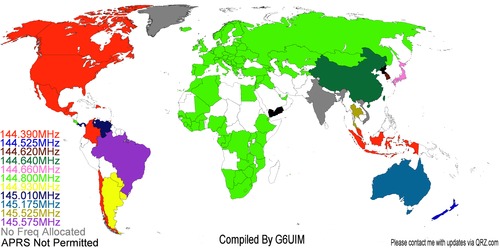
APRS operates on 144.39 MHz throughout North America. Other countries use different frequencies.
APRS VHF World Map
Weather Station Reporting: APRS position reports can include wind speed, direction, and other weather data. Many APRS programs support home weather stations and can display NWS data and WX alarms.
DX Clusters: APRS is an ideal tool for DX cluster users, allowing real-time display of DX spots with reduced packet load.
APRS Internet System (APRS-IS): APRS has been fully integrated with the Internet since 1997. Sites such as APRS.FI and FINDU.COM allow global viewing of APRS activity.
Frequency Coordination: APRS is an excellent tool for monitoring network topography and assisting with frequency coordination.
Protocol: APRS prioritizes new data over old. Packets are transmitted immediately, then at increasing intervals, stabilizing at 10 minutes times the number of digipeater hops.
Byonics Tiny Trak 4
What is Required for APRS? It is much easier, simpler and inexpensive than most people think. All you need is a radio (a handheld will work), a Packet TNC or a specially created APRS TNC like the Tiny Trak, and a GPS unit. This is probably the most common option that many hams use. The Tiny Trak is very affordable and can be purchased as a kit or already assembled. Byonics, the creator of the Tiny Trak, even sells pre-made cables for the Tiny Trak and your radio. So you connect the GPS to the Tiny Trak, the Tiny Trak to the radio and as soon as the GPS is locked on the signals from the satellites, it will start beaconing your position.
Byonics All-In-One AIO 2
Kenwood D72 APRS HT
In recent years, all-in-one APRS radios have become available from Byonics, Yaesu, and Kenwood. These units combine radio, TNC, and GPS into a single device for convenience and portability.
© 1993 – Benton Amateur Radio Society (B.A.R.S.), All Rights Reserved – Questions or Comments about this website, please contact the webmaster.